Introduction
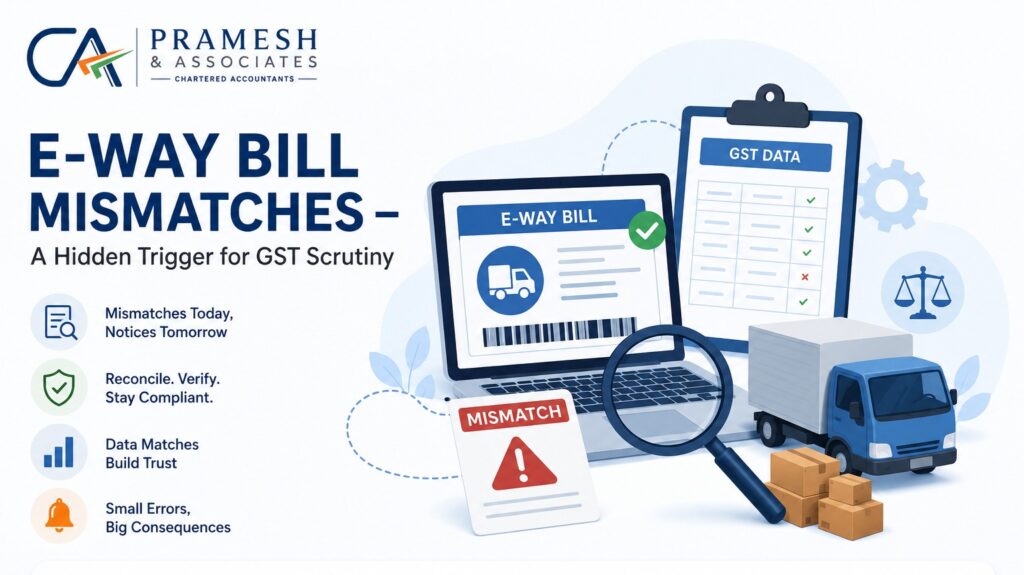
E-Way Bills have become an important source of information for GST authorities when assessing taxpayer compliance. With advanced data analytics and cross-verification mechanisms, tax departments increasingly compare E-Way Bill data with GST returns, invoices and accounting records to identify potential discrepancies.
Even when taxes are correctly paid, inconsistencies in E-Way Bill reporting may trigger departmental inquiries, scrutiny notices and further investigations.
Common Mismatch Scenarios
Some of the most frequently observed E-Way Bill discrepancies include:
- E-Way Bill value differing from invoice value
- Movement of goods without corresponding GST reporting
- Incorrect or incomplete Part-B details
- Unreconciled stock transfers between locations
- Incorrect classification of transactions
- Cancelled E-Way Bills not properly tracked
- Errors in quantity, vehicle number or consignee details
These mismatches often attract attention during GST audits and compliance reviews.
Why Authorities Scrutinize E-Way Bill Data
GST authorities use E-Way Bill information to verify whether reported business transactions are consistent with GST returns and financial records. Common areas of verification include:
- Goods movement versus outward supply reporting
- Invoice values versus E-Way Bill values
- Inter-state transactions
- Stock transfer documentation
- Return disclosures and tax payments
Any significant discrepancy may lead to requests for clarification and supporting documentation.
Potential Consequences
Failure to address E-Way Bill mismatches can result in:
- GST notices and departmental inquiries
- Detailed compliance scrutiny
- Detention of goods and conveyances
- Tax and penalty demands
- Increased litigation and compliance costs
Timely identification and correction of discrepancies can help reduce these risks.
Compliance Tips
Businesses should establish strong controls over E-Way Bill management by:
- Conducting regular reconciliation of E-Way Bill data
- Matching E-Way Bills with invoices and GST returns
- Maintaining proper documentation for stock movements
- Reviewing cancelled and amended E-Way Bills
- Verifying vehicle and transporter details before generation
- Implementing periodic internal compliance reviews
A proactive approach helps ensure consistency across all compliance records.
Importance of Documentation
Proper documentation plays a crucial role in defending transactions during departmental scrutiny. Businesses should maintain:
- Invoice copies
- Transport documents
- Delivery challans
- Stock transfer records
- E-Way Bill reconciliation statements
These records help substantiate the movement of goods and support GST compliance.
Conclusion
E-Way Bill compliance should not be viewed merely as a transportation requirement. It is an integral part of the GST compliance framework and a key area of departmental scrutiny. Regular reconciliation, accurate reporting and proper documentation can help businesses avoid unnecessary notices, penalties and disputes.